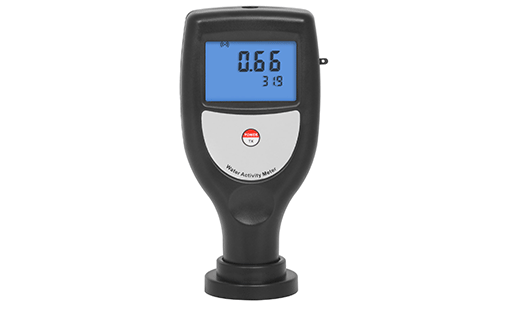

Water activity is a measurement of the availability of water for biological reactions. Determines the ability of microorganisms to grow. If the water activity decreases, the microorganisms that have the ability to grow will also decrease.
Water activity (aw) is expressed as the ratio of the vapor pressure in the food (P) to the vapor pressure of pure water (P0). It predicts whether water is likely to move from the food product into the cells of microorganisms that may be present. Water content alone is not sufficient information to determine food safety or predict product shelf life. The relationship between water content and AV is complex and is related to the relative humidity of the food and its water content. This ratio must be determined for each specific food. It is easy to assume that food with a higher water content will have a higher AV than dry food. This is not always true. It is possible to have products with the same water content, but very different water activities. For example, salami and cooked beef have a similar water content of approximately 60 percent. However, the water activity of salami is 0.82 and that of cooked beef is approximately 0.98.
Most foods have an AV greater than 0.95 which supports the growth of bacteria, yeast and mold. Knowledge of AV in food is important when preparing a plan (HACCP). Determining the water activity of a product or ingredient is essential when conducting hazard analysis for many products.
Measuring water content can be useful in some situations such as yield determination. Water activity, however, is a more suitable measurement for predicting food safety and quality.